Redemption
Paradise LostRedemption is the state and process by which humanity, condemned through disobedience, is restored rather than abandoned to Death and Hell. Its decisive structure is substitution: human beings have incurred a debt they cannot pay, while the Son of God voluntarily becomes Man, offers life for life, undergoes death, rises victorious, and makes his obedience and merit available to those who receive grace through faith. The poem therefore presents Redemption as the triumph of divine love over sin without abolishing justice.
The Human Crisis and the Need for Redemption
Humanity’s need for Redemption begins with the violation of the command concerning the Tree of Knowledge of Good and Evil. The prohibition was not merely a restriction of appetite; it marked the boundary between creaturely obedience and the desire to possess godlike knowledge by forbidden means. After Eve tastes the fruit, Adam reasons that the threatened penalty may not truly be enforced, since the Serpent appears to have survived and seems to have gained a higher condition of life. He also fears that the destruction of humanity would make God’s creation appear unstable and allow the Adversary to claim a victory. His reasoning does not remove guilt, but it reveals the unstable condition in which human beings seek to explain away the consequences of disobedience.
The theological sentence is exacting. Humanity’s disloyalty against the supremacy of Heaven leaves no human offering adequate to expiate the offense: the offender must die, unless another being both able and willing can pay the required satisfaction. The language is explicitly one of obligation, forfeiture, payment, ransom, and substitution. Yet the debt is not treated as a commercial bargain between equal powers. It arises from violated justice, and only an act that genuinely enters the human condition can answer it.
The Son of God’s Voluntary Mediation
When Heaven offers no patron or intercessor capable of assuming humanity’s deadly forfeiture, the Son of God intervenes. He offers himself in humanity’s place, asking that divine anger fall upon him and declaring his willingness to leave the Father’s bosom and heavenly glory, become Man, and die for the human race. His action is voluntary rather than compelled. He does not seek escape from death, but accepts it as the necessary cost of restoring those who cannot seek an atonement for themselves while dead in sins.
The Father accepts this mediation and defines its incarnational form. The Son of God must join human nature to his own, become flesh through a wondrous birth from Virgin seed, and stand in Adam’s place as the head of mankind. Adam’s transgression makes his descendants guilty; the Son’s merit can absolve those who renounce both their righteous and unrighteous deeds, live in him, and receive new life from him. Humanity therefore satisfies justice through a representative who is truly human, while the dignity of the Son is not diminished by humiliation. His willingness to descend is itself presented as the ground of his exaltation: he is judged worthy of universal kingship because love has abounded in him more than glory.
Obedience, Death, and the Defeat of Sin
Redemption does not occur through the destruction of Satan in a simple duel. Michael explains that the promised victory over the Serpent consists in undoing Satan’s works within Adam and his descendants. The Son of God must fulfill the law that Adam failed to obey, both through obedience and through love, since love alone perfectly fulfills the law. He then endures the punishment due to human transgression by entering the flesh, living a reproachful life, suffering judgment, and dying a cursed death on the Cross.
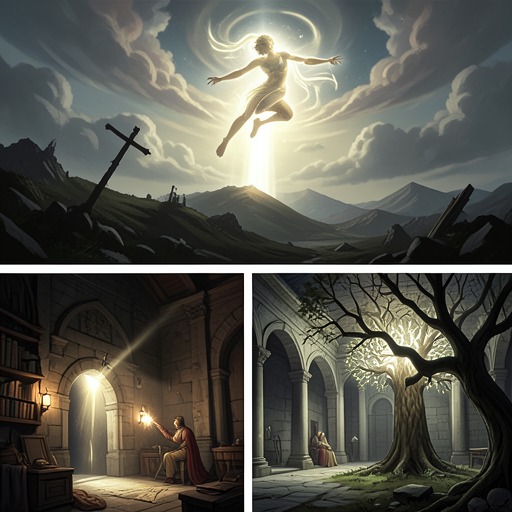
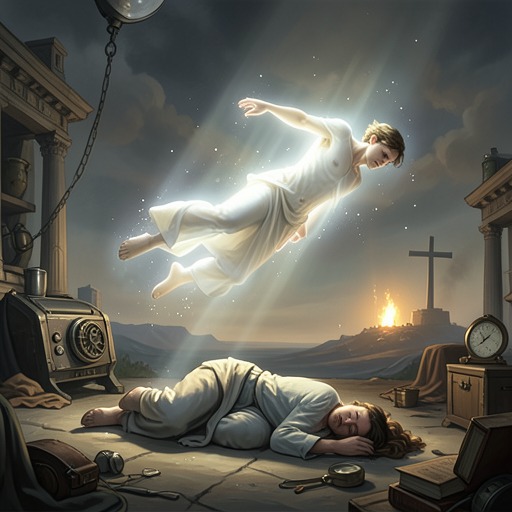
The Cross is consequently both punishment and reversal. The Son bears the sentence that humanity should have borne, while the law standing against humanity and the sins of mankind are figuratively nailed with him and deprived of their power over those who trust in his satisfaction. His death is not the final condition of Redemption. He rises before the third dawn, and Death cannot retain him. The ransom is thereby declared paid: the death that would have left humanity eternally lost becomes, for those who embrace the offered life, the passage toward immortal life. The image of death as a conquered power is sharpened by the prediction that the Son will return from the grave victorious, disarm Death, and lead the powers of darkness captive.
Grace, Faith, and the Scope of Salvation
The Father’s decree distinguishes Redemption from human deserving. Humanity will not be wholly lost, but those who are saved are saved by grace freely granted by God, not by an independent power of will in fallen humanity. God renews humanity’s lapsed powers and places it again on an even ground against its mortal foe, while ensuring that deliverance is owed to God rather than to human self-sufficiency. Some are chosen by peculiar grace; others hear the divine call, are warned of their sinful condition, and are invited to appease the offended Deity while grace is offered.
This grace is not represented as permission for indifference. God promises to receive sincere prayer, repentance, and obedience, and places conscience within human beings as an internal guide through which light may follow light. Those who persist in responding may arrive safely; those who scorn the day of grace become harder and blinder, excluding themselves from mercy through continued refusal. Faith is therefore not empty assent. Redemption is received by faith, but the faith described in the poem is not void of works: it is joined to obedience, love, repentance, and a life transformed by the merits of the redeemer rather than by reliance on legal performance.
Historical Mediation and Final Restoration
Before the Incarnation, the law and its ceremonies prepare humanity to recognize the insufficiency of ordinary sacrifice. Through Moses, laws and rites are established, and the Tabernacle becomes a sign of divine presence among mortal people. Its Sanctuary contains the Ark and the testimony of the covenant, with a golden mercy-seat between the Cherubim and lamps representing heavenly fires. These rites disclose sin but cannot remove it; the blood of bulls and goats is only a shadow of the more precious blood required for humanity. Their function is therefore pedagogical and anticipatory, directing faith toward the future act in which the just will suffer for the unjust.
The Son of God’s redeeming work extends beyond one nation. After rising, he appears to his disciples, charges them to teach all nations, and makes baptism a sign of washing from guilt into pure life. Salvation is preached not only to the descendants of Abraham but to the descendants of Abraham’s faith wherever they live. The Son then ascends through the air in triumph, resumes his seat at God’s right hand, and sends the Spirit to guide and strengthen his followers. The Law of Faith works through love within their hearts, while spiritual armor enables them to resist Satan’s assaults; their ministry carries the news of Redemption across nations.
Redemption reaches its complete horizon at the dissolution of the present world. The Son of God returns in glory and power to judge the living and the dead, condemning the unfaithful while receiving the faithful into bliss. The final result is not merely a return to the prelapsarian Garden of Eden. The renewed Earth becomes Paradise, promised to be happier than Eden, so that the trajectory from fall to restoration produces a condition more secure and more expansive than the original innocence. The poem’s governing reversal is thus that evil, though genuinely destructive, becomes the occasion through which divine grace, love, justice, and restored life are made most fully manifest.